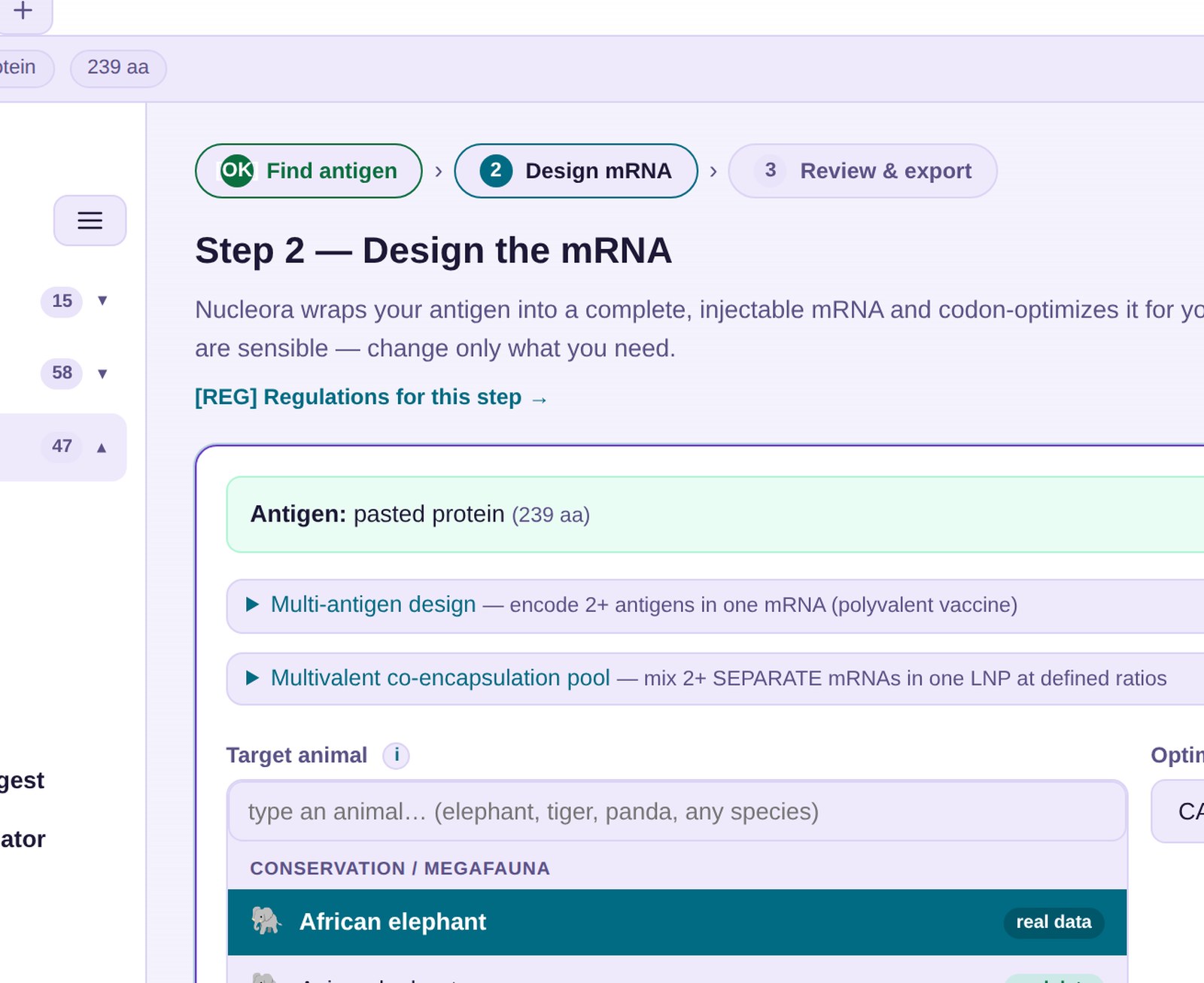
Nucleora opens on a guided three-step vaccine workflow. Behind it sits a full sequence-editing, cloning, CRISPR, manufacturing, and compliance platform: 350+ individual tools, organized into nine workspaces.
Type an animal: elephant, tiger, panda, any species. Nucleora tells you plainly whether it has real codon usage tallied from RefSeq coding sequences, or whether it's optimizing against a documented, clade-anchored proxy. Nothing is silently approximated.
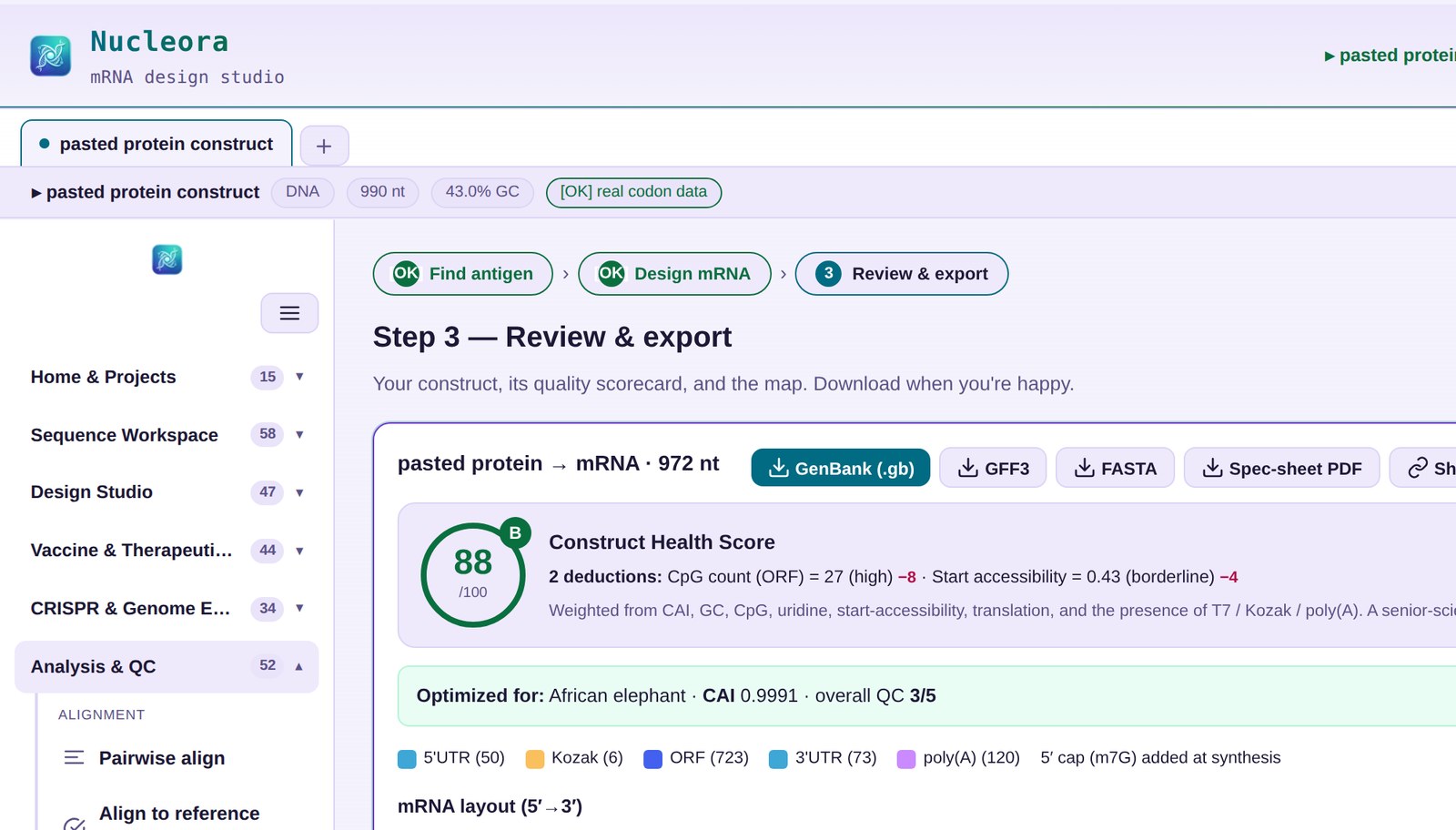
Every finished construct gets a weighted score (CAI, GC%, CpG, uridine fraction, start-codon accessibility, translation, and the presence of T7/Kozak/poly(A)), a full parts-and-provenance breakdown with citations, and one-click GenBank, GFF3, FASTA, and spec-sheet PDF export.
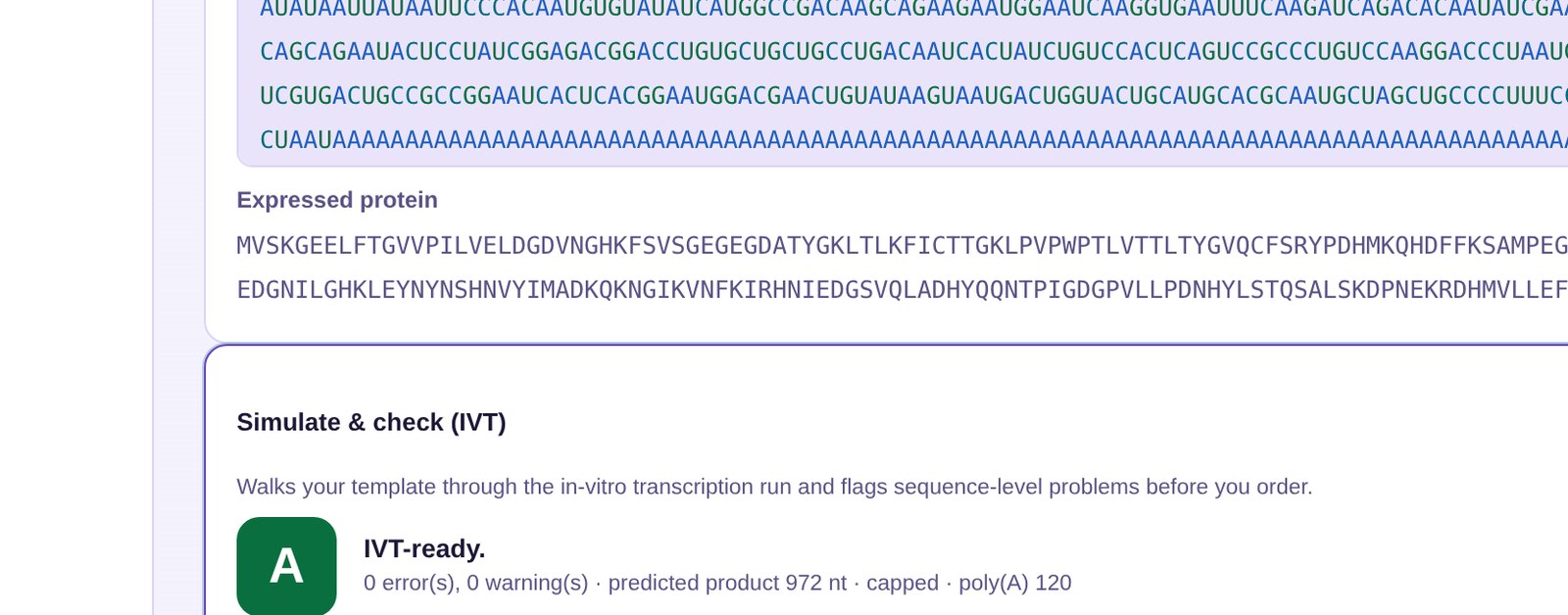
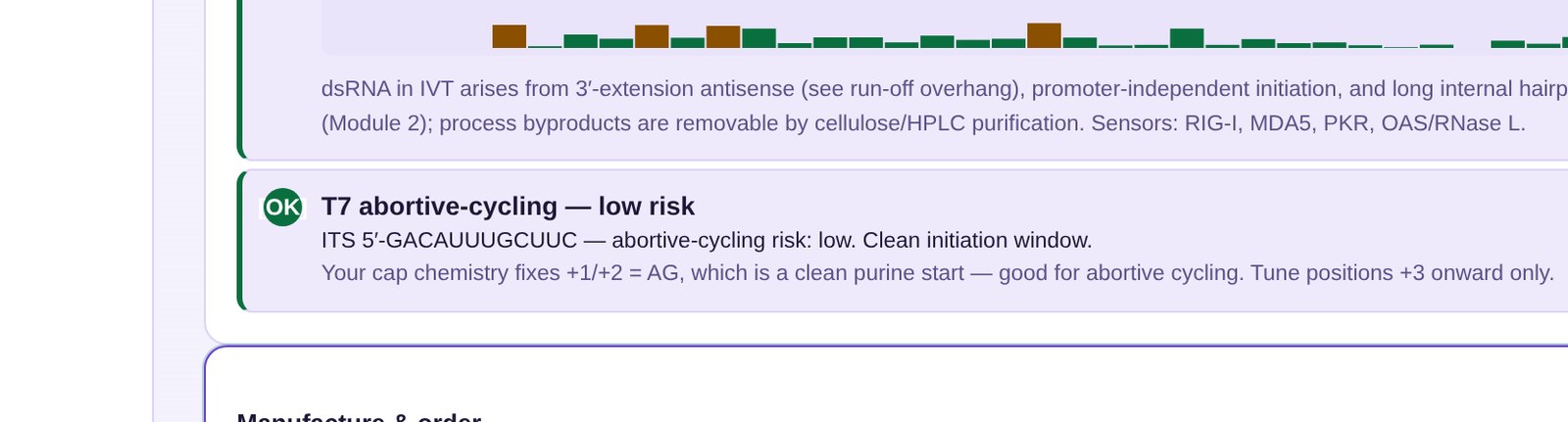
The “Simulate & check” panel walks your template through linearization, T7 transcription, capping, and poly(A) tailing, then produces a graded (A–D / Fail) manufacturability report. It flags missing promoters, ORF/frame errors, homopolymer runs, cryptic polyadenylation signals, dsRNA/immunostimulation risk, and more, each with a plain-language fix.
Enter a reaction spec (volume, NTP concentration, template mass, T7 units and enzyme-lot activity, temperature, time, cap method, modified-U, µg/dose) and Nucleora computes yield as the smallest of three physical
A real, unscripted walkthrough of the actual engine. No mockups, no staged data.
Watch the demo